How Long Carpet Really Takes to Dry, and Why Ours Doesn't
Hot water extraction leaves more moisture behind than most people realize, and that moisture is exactly what brings old stains back days later.
September 14, 2026 · 4 min read
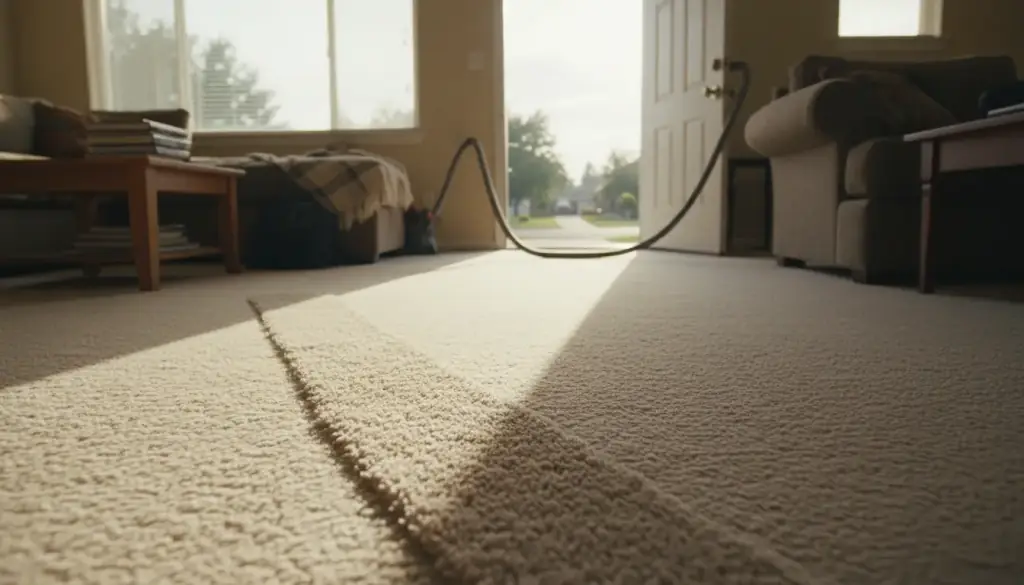
A carpet that looks dry on the surface can still be soaked two inches down, right at the backing. That gap between what you see and what's actually happening inside the pile is where most complaints about carpet cleaning start, and it usually has nothing to do with how good the technician was.
What hot water extraction actually does
Hot water extraction, sometimes called steam cleaning even though no actual steam is involved, forces hot water and a cleaning solution into the carpet pile under pressure, then pulls it back out with a wand connected to a vacuum. It's a legitimate method and plenty of companies do it well. But no wand recovers everything it puts down. Some water always stays behind, held in the twist of the fiber, in the carpet backing, in the pad underneath, and sometimes in the subfloor itself if the carpet has been wet before and the pad has lost some of its bounce.
Why the drying window runs four to twenty four hours
That range is wide because drying time depends on more than the cleaning itself. Humidity in the room, airflow, how thick the pad is, whether the carpet sits over concrete or wood subfloor, and how dense the pile is all change how long the moisture takes to work its way out. A single room with a ceiling fan running and a window cracked might be walkable in four or five hours. A hallway with no airflow, laid over concrete, in a humid week, can still feel damp the next evening. Most companies will tell you six to twelve hours as an average and mean it honestly. The problem is what happens inside that window, not just how long it lasts. Finished basements are their own category entirely, since they combine poor airflow with concrete underneath and often sit below ground level where ambient humidity is already higher than the rest of the house, so a basement carpet cleaned with a wet method can take the full twenty four hours or more before it's genuinely dry.
How technicians check before they call it dry
A quick way to tell if carpet is still holding water is to press a clean white towel flat against the pile for about ten seconds. If it comes up damp or cool to the touch, there's still moisture working its way through, even if the top of the carpet feels dry to a bare hand. Most technicians who do wet extraction carry a moisture meter for exactly this reason, because guessing by touch alone is unreliable past the first couple of hours, and the meter can catch a damp pad long before it would ever show up on the surface.
What wicking actually is
As the water trapped deep in the carpet slowly evaporates upward through the pile, it carries whatever's dissolved in it along for the ride and deposits it right at the tip of the fiber as it dries. That's wicking. A spot that rinsed out clean, that the technician checked before they left, can reappear two or three days later as a faint ring in exactly the same spot. It isn't that the cleaning failed. It's that the water finished the job after the crew was already gone, redepositing soil the extraction never fully removed from lower in the pile. Homeowners understandably read this as a bad clean. Mostly it's just physics.
What a dry compound clean does instead
We use a dry cleaning compound, a fine, absorbent material that gets worked down into the carpet pile with counter rotating brushes. The compound is what does the actual cleaning: it holds detergent, breaks soil loose from the fiber, and absorbs it into itself as it works through. Then it gets vacuumed straight back out, soil and all. No water is added at any point, so there's nothing sitting in the backing or the pad waiting to evaporate, and nothing to wick back up two days later. Our dry cleaning process allows for immediate use of your carpets after service completion. There's no need to wait as our method leaves no residual moisture.
- Humidity and how much airflow the room gets
- Pad thickness and how much water it can hold
- Whether the carpet sits over concrete or wood subfloor
- Pile density and fiber type
Why this matters more than it sounds like
For a home with kids and pets back on the carpet within the hour, that difference is convenience. For a business that can't rope off a lobby or a reception area for a day, it's the difference between scheduling a clean at all or putting it off another quarter. We get asked fairly often whether dry cleaning is 'as good' as steam cleaning. It's a different tool for a different problem, and for carpet that needs to go straight back into use, it's the one that doesn't leave you waiting to find out if the stain is really gone.
Brilliant Dry Carpet Care, (380) 285-7131
Call (380) 285-7131More articles
Getting Pet Stains and Pet Odor Out of Carpet for Good
Pet odor usually lives in the carpet backing and pad, not on the surface, which is why sprays and powders only ever work for a day.
What to Do in the First Ten Minutes of a Carpet Spill
The first ten minutes after a spill decide more about whether it comes out than anything a cleaning crew can do afterward.